
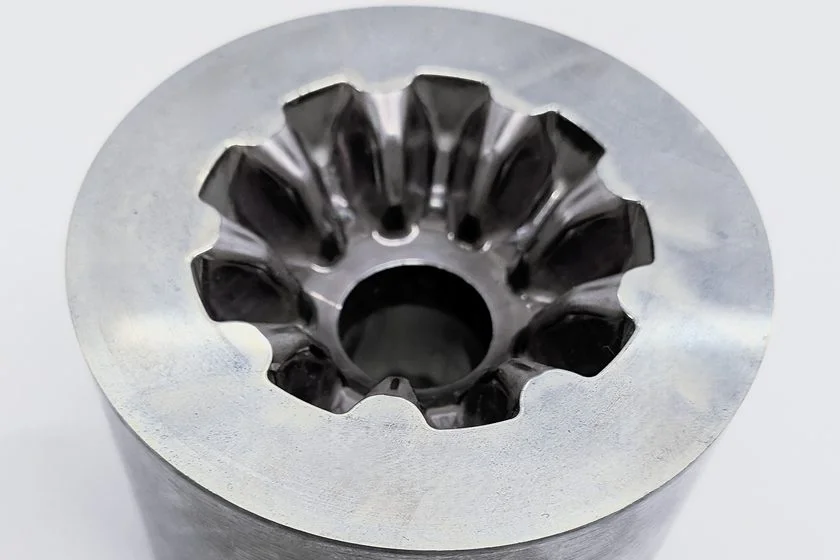
Cemented carbide refers to a composite alloy material primarily made of tungsten carbide (WC) and cobalt (Co), offering hardness second only to diamond.
In modern manufacturing, it plays a critical role in determining the tool life, precision, and performance of cutting tools and dies. However, despite its exceptional hardness, it is brittle and sensitive to impact, making correct material selection essential in practical applications.
This article provides a comprehensive guide to cemented carbide properties, types, advantages and disadvantages, comparisons with HSS (high-speed steel), and JIS classification (P, M, K grades) for proper industrial use.
What You’ll Learn in This Guide
- Definition of cemented carbide and the manufacturing process behind its extreme hardness
- Key differences in performance and cost compared to HSS, cermet, and other materials
- How to select the right JIS grade (P, M, K) based on workpiece materials
- Practical tips to improve tool life and machining accuracy
What Is Cemented Carbide? Composition and Manufacturing Process
Cemented carbide is produced by bonding extremely hard metal carbide particles with a metallic binder such as cobalt, followed by sintering at high temperatures.
It is widely used in:
- Cutting tools (drills, inserts, end mills)
- Press dies and molds subjected to extreme pressure
where wear resistance, strength, and durability are essential.
Key Physical Properties
| Property | Typical Value |
| Hardness | HRA 80–94 (second only to diamond) |
| Density | 13–15 g/cm³ (about twice that of steel) |
| Heat | Resistance Maintains hardness at 800–1,000°C |
| Rigidity | Young’s modulus approx. 3× that of steel |
Main Components of Cemented Carbide
Cemented carbide is composed of the following key elements:
- Tungsten Carbide (WC)
Provides hardness and wear resistance - Cobalt (Co)
Acts as a binder, improving toughness and preventing chipping - Additives (TiC, TaC, etc.)
Enhance heat resistance and prevent adhesion during high-speed cutting - Additional elements (Ni, Cr, etc.)
Improve corrosion resistance when required
Powder Metallurgy: Why It Is Not Melted
Cemented carbide cannot be formed through conventional melting processes due to tungsten carbide’s extremely high melting point (~2,900°C).
Instead, it is manufactured by powder metallurgy, which involves:
- Mixing fine powder materials
- Pressing them into shape
- Sintering at around 1,400°C
During sintering, cobalt melts and fills gaps between particles, forming a dense, highly durable material.
Differences Between Cemented Carbide, HSS, and Cermet
Choosing the right tool material is crucial for balancing performance and cost.
Comparison Table
| Property | Cemented Carbide | HSS (High-Speed Steel) | Cermet | Diamond (PCD) |
| Hardness (HV) | 1,200 ~ 1,800 | 850 ~ 950 | ~1,500 | 8,000~10,000 |
| Heat Resistance | 800~1,000°C | 500 ~ 600°C | ~1,100℃ | 600~700℃ |
| Toughness | Low | High | Low | Very low |
| Rigidity | Very high | Medium | High | Very high |
| Main Use | High-speed machining | Small-batch, impact loads | Finishing steel | Non-ferrous precision |
Cemented Carbide vs HSS
- Cemented carbide offers 3× higher rigidity, enabling precise dimensional accuracy
- HSS provides higher toughness, making it suitable for:
・Interrupted cutting
・Older or less rigid machines
Cemented Carbide vs Other Materials
- Cermet → Ideal for finishing steel surfaces due to low affinity
- Diamond (PCD) → Extremely hard but limited to non-ferrous metals
- Ceramics → Excellent heat resistance but brittle
JIS Classification: How to Select the Right Grade
Cemented carbide grades are categorized by JIS standards based on workpiece materials.
Main Grades
| Property | Color | Suitable Materials | Features |
| P | Blue | Steel, alloy steel | Heat & adhesion resistance |
| M | Yellow | Stainless steel | Balanced toughness & heat resistance |
| K | Red | Cast iron, non-ferrous | High wear resistance |
Additional Categories
- N (Green) → Aluminum and non-ferrous metals
- S (Brown) → Heat-resistant alloys
- H (Gray) → Hardened materials
How to Select the Right Grade (3-Step Process)
- Identify workpiece material (steel, cast iron, stainless)
- Determine cutting conditions (continuous or interrupted)
- Set priorities (wear resistance vs toughness)
Ultra-Fine Grain Carbide
Ultra-fine grain carbide uses smaller WC particles (0.5–0.7 μm), achieving:
- Higher toughness without sacrificing hardness
- Improved performance in small-diameter tools and precision machining
Advantages of Cemented Carbide
| Advantage | Practical Benefit |
| High wear resistance | Longer tool life |
| Heat resistance | Enables high-speed machining |
| High rigidity | Maintains precision and tolerances |
Disadvantages and Considerations
| Disadvantage | Risk |
| Brittleness | Susceptible to chipping |
| Thermal shock sensitivity | Requires careful cooling control |
| High density | Handling challenges |
Supply Risk: Tungsten Shortage
Tungsten, a key component, is a critical rare metal with supply risks due to:
- Geographic concentration
- Increasing global demand
- Environmental regulations
This can cause:
- Price fluctuations
- Longer lead times
Manufacturers increasingly adopt strategies such as:
- Reducing carbide usage
- Using alternative materials
Machining Methods for Cemented Carbide
Due to its hardness, specialized processing is required:
- Diamond grinding → High precision finishing
- Electrical discharge machining (EDM) → Complex shapes
- Laser machining → Fine, non-contact processing
- Lapping → Mirror surface finishing
Applications Across Industries
| Industry | Applications | Reason |
| Metalworking | Tools, inserts | High-speed machining capability |
| Mold & die | Forming dies | High compressive strength |
| Infrastructure | Excavation tools | Extreme wear resistance |
| Aerospace/Medical | Titanium machining | Heat resistance |
Cost Optimization Strategies
Although cemented carbide has a higher initial cost, it reduces total costs through:
- Longer tool life
- Increased productivity
- Reduced downtime
Green Machining (Pre-Sintering Processing)
Machining before full sintering:
- Lower processing cost
- Reduced need for expensive finishing operations
Conclusion: Maximizing Cemented Carbide Performance
Cemented carbide is essential for modern precision manufacturing, offering unmatched hardness and wear resistance. However, successful implementation requires:
- Proper material selection (JIS grades)
- Consideration of brittleness and machining methods
- Optimization for lifecycle cost
When selected and applied correctly, cemented carbide significantly improves tool life, machining efficiency, and product quality.
FAQ
Q: When should carbide be used instead of cermet?
A: Carbide is ideal for roughing and heavy cutting; cermet is better for finishing.
Q: What is a typical hardness value?
A: Most carbide materials range around HRA 88–92.
Q: Does carbide rust?
A: The cobalt binder may corrode under certain conditions (de-cobaltization).
Q: Can carbide tools be recycled?
A: Yes. They can be re-ground or recycled to recover tungsten.


