
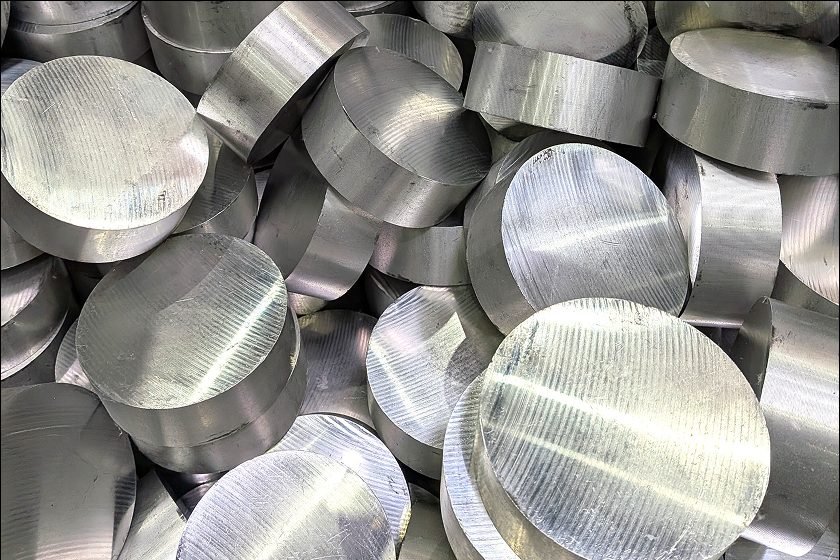
Aluminum forging is a manufacturing process in which aluminum alloys are shaped under high pressure using presses or hammers, while simultaneously refining the internal metal structure. This process not only forms the material but also enhances its mechanical properties at a microscopic level.
By combining aluminum’s lightweight nature—approximately one-third the density of steel—with forging, it is possible to achieve the high strength and reliability required for critical components in industries such as aerospace and automotive.
In this article, we explain the key features, advantages and challenges, process types, and design considerations for cost reduction in aluminum forging.
What You Will Learn
- The fundamental characteristics of aluminum forging and how it differs from casting and machining
- The differences between hot and cold forging processes and their optimal applications
- Key criteria for selecting the right aluminum alloy for your application
What Is Aluminum Forging?
The Key to Strength and Toughness
Aluminum forging is a process that applies immense pressure to aluminum alloys, deforming the material into shape while simultaneously strengthening its internal structure. Unlike simple shaping methods, forging improves the material’s mechanical performance at the microstructural level.
One of the most critical aspects of forging is the grain flow (fiber flow) created within the material. This internal structure is essential for achieving high reliability, especially in demanding environments.
Improved Durability Through Grain Flow
During forging, the metal’s grain structure becomes aligned along the shape of the component, forming a continuous, uninterrupted flow. This is known as grain flow or fiber flow.
Compared to:
- Casting, which creates a random internal structure
- Machining, which cuts and disrupts the grain
forged components maintain structural continuity. This alignment improves resistance to stress, impact, and fatigue, resulting in longer product life.
Additionally, internal voids are compressed during forging, increasing material density and overall durability.
Advantages and Challenges of Aluminum Forging
Benefits: Lightweight and High Strength
Aluminum is significantly lighter than steel or copper, enabling substantial weight reduction in finished products. When forged, aluminum offers:
- High tensile strength
- Excellent impact resistance
- Improved fuel efficiency (especially in automotive applications)
- Enhanced handling and performance
For example, replacing steel components with forged aluminum can reduce weight without sacrificing strength, leading to better fuel economy and vehicle dynamics.
Aluminum is also highly recyclable and generates less material waste, making it an environmentally friendly choice.
Challenges: Processing Complexity and Initial Costs
Aluminum forging requires precise control due to its relatively low melting point and narrow processing window:
- Excessive temperature → surface defects
- Insufficient temperature → cracking or incomplete filling
Additional challenges include:
- Lubrication control and prevention of galling (adhesion)
- High initial cost for precision dies
However, these drawbacks are often offset by:
- Cost advantages in mass production
- Reduced secondary processing
- Higher overall productivity
Forging vs Casting vs Machining
| Feature | Forging | Casting | Machining |
| Strength & Toughness | Very High | Moderate | Moderate (material-dependent) |
| Material Loss | Low | Very Low | High |
| Reliability | Extremely High | Risk of porosity | Depends on raw material |
| Cost (Mass Production) | Low | Low | High |
Types of Aluminum Forging Processes
Hot Forging (300°C–480°C)
Performed above the recrystallization temperature, hot forging softens the material and allows large deformation under lower pressure.
Advantages:
- Suitable for large and complex shapes
- Improved mechanical properties through grain refinement
Typical applications:
- Automotive suspension arms
- Structural components
Cold Forging (Room Temperature)
Cold forging is performed below the recrystallization temperature, often at room temperature.
Advantages:
- Excellent dimensional accuracy
- Superior surface finish
- Reduced need for secondary machining
Typical applications:
- Bolts and fasteners
- Small precision parts
Note: Requires advanced die design and lubrication due to high forming loads.
How to Select Aluminum Alloys for Forging
The performance of a forged part depends heavily on the alloy composition. Key alloy series include:
- 2000 Series (Al-Cu)
・High strength (e.g., duralumin)
・Used in aerospace applications
・Requires corrosion protection - 6000 Series (Al-Mg-Si)
・Balanced strength, corrosion resistance, and workability
・Most widely used in automotive and construction - 7000 Series (Al-Zn-Mg)
・Among the highest-strength aluminum alloys
・Used in aerospace and high-performance applications
・Requires careful heat treatment to prevent stress corrosion cracking
Selecting the right alloy based on operating environment and required durability is essential.
Manufacturing Process and Quality Control
Achieving consistent high quality requires tight control across all stages—from design to final inspection.
Simulation technologies enable:
- Visualization of material flow
- Prediction of residual stress
- Early detection of defects
This data-driven approach ensures reliability in demanding industries such as aerospace and automotive.
Cost Reduction Through Design
Effective cost reduction starts at the design stage. Two key approaches are:
- Near-Net Shape Design
・Minimizes material waste
・Reduces machining time - Part Integration
・Combines multiple components into one
・Reduces assembly steps
・Improves structural integrity
| Method | Cost Reduction Effect | Quality Benefit |
| Near-Net Shape | Less material loss, reduced machining | Stable precision |
| Part Integration | Fewer components and assembly steps | Higher strength |
Aluminum Precision Forging for Next-Generation Manufacturing
Aluminum forging enables manufacturers to combine lightweight properties with exceptional strength and reliability. Its defining advantage lies in grain flow, which enhances fatigue resistance and product lifespan beyond what casting or machining can achieve.
By selecting the appropriate:
- Forging method (hot vs cold)
- Alloy series (6000, 7000, etc.)
- Design strategy (near-net shape, integration)
companies can achieve both high performance and cost efficiency.
FAQ
Q1. Is forging more cost-effective than casting?
While casting generally has a lower unit cost, forging enables thinner, smaller, and stronger components. When considering lifecycle cost, forging often provides better overall value.
Q2. Does replacing steel with aluminum reduce strength?
Not necessarily. With proper alloy selection and forging, aluminum components can achieve comparable strength while significantly reducing weight.
Q3. Can aluminum forging be used for small-lot production?
Yes. It is suitable for both prototyping and mass production, especially when transitioning from machining-based processes.
Q4. How do I choose the right alloy?
- 7000 series: highest strength
- 6000 series: best balance of cost and performance
Selection depends on application requirements such as corrosion resistance and machinability.


