
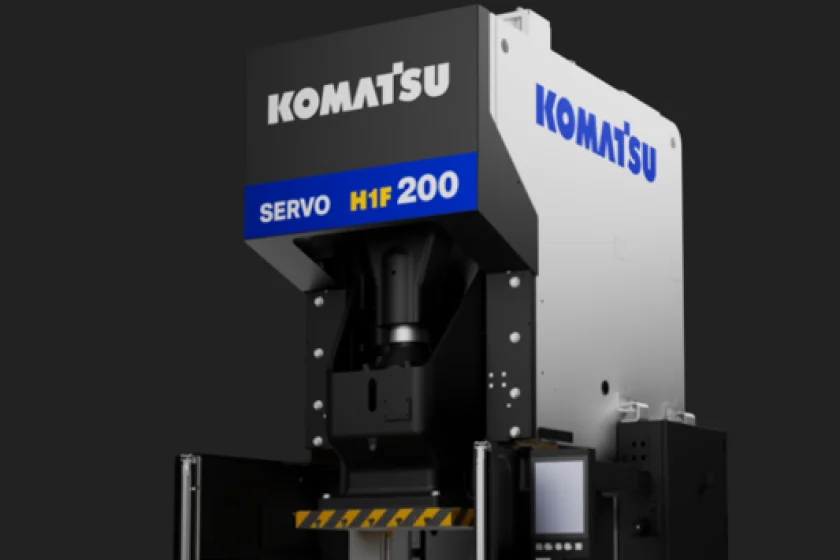
A servo press is a type of press machine that uses a servo motor as its drive source, enabling precise and flexible control of slide motion through programmable settings.
Unlike conventional presses, a servo press allows optimal pressure control tailored to each processing condition, making it possible to achieve high-precision forming, improved product quality, and complex geometries.
In this article, we provide a detailed explanation of servo press mechanisms, types, advantages and disadvantages, and differences from mechanical and hydraulic presses.
What You’ll Learn in This Article
- The basic mechanism of servo presses and their main drive systems
- Key differences between servo presses, hydraulic presses, and mechanical presses
- Benefits of introducing servo presses and important drawbacks to consider
- The relationship between machines and dies for achieving net-shape forming
What Is a Servo Press? Structure and Working Principle
A servo press is a press machine in which the slide (ram) is driven by a servo motor, and its motion is controlled by numerical control (NC).
While conventional mechanical presses rely on flywheel inertia to repeat fixed movements, servo presses use electrical signals to achieve fully programmable motion control—delivering the right speed and force exactly when needed.
Principle of Electronic Control Using a Servo Motor
The defining feature of a servo press is its ability to freely program slide motion patterns. The process works as follows:
- Command Output
The controller sends signals based on pre-programmed motion patterns - Motor Rotation
The servo motor rotates precisely according to the signal - Motion Conversion
Rotational motion is converted into linear motion using mechanisms such as ball screws or crank systems - Real-Time Feedback Control
Sensors continuously monitor position, speed, and load, enabling instant correction through high-speed feedback
This system enables advanced operations such as:
- High-speed approach before contact
- Slow, controlled forming at the moment of pressing
resulting in a balance between high productivity and high-quality forming.
Key Components of a Servo Press
A servo press integrates advanced electronics with a robust mechanical structure:
| Component | Role / Feature |
| Servo Motor | Main drive source, precisely controls speed and torque |
| Controller / Driver | Executes motion programs and controls system behavior |
| Ball Screw / Crank | Converts rotation into vertical slide motion |
| Sensors | Detect position, speed, and load for feedback control |
| Frame | High-rigidity structure that maintains precision under load |
| Interface | Touch panel for operation and data monitoring |
These components work together to enable processing of difficult-to-form materials (e.g., magnesium, high-strength steel) and complex shapes.
Differences Between Servo, Mechanical, and Hydraulic Presses
The fundamental differences lie in the drive system and control flexibility.
| Item | Servo Press | Mechanical Press | Hydraulic Press |
| Drive Source | Servo motor | Flywheel / crank | Hydraulic pump |
| Motion Control | Fully programmable | Fixed motion | Limited precision control |
| Accuracy | Very high (micron-level) | Medium | Lower (affected by temperature) |
| Energy Efficiency | Very high | Low | Low |
| Maintenance | Clean, low noise | Higher vibration | Oil management required |
| Applications | Precision forming, complex parts | Mass production (simple parts) | Deep drawing, heavy forming |
Why Companies Are Switching to Servo Presses
Many manufacturers are upgrading to servo presses due to three major advantages:
- Significant Energy Savings
Servo presses consume power only during operation.
・Up to 80% reduction in energy consumption compared to hydraulic presses - Improved Yield and Quality
・Real-time load correction reduces defects such as cracks and wrinkles
・Stable processing even with material variation - Extended Die Life
・“Soft touch” reduces impact at contact
・Lower wear and reduced maintenance frequency
Types of Servo Presses by Drive System
Servo presses are categorized by how motor rotation is converted into linear motion.
- Screw (Ball Screw) Drive
Features:
・High precision in position and load control
Advantages:
・Micron-level positioning accuracy
・Ideal for precision press fitting and intricate forming
Considerations:
・Requires care under high-speed impact conditions - Crank (Direct Drive) System
Features:
・Combines speed of mechanical presses with servo control
Advantages:
・High productivity
・Suitable for automotive mass production
Considerations:
・Load varies depending on stroke position - Hybrid (Link / Hydraulic) System
Features:
・Combines servo control with link mechanisms or hydraulic systems
Advantages:
・High forming force with precise control
・Suitable for deep drawing and cold forging
Key Benefits of Servo Presses
1. High Precision and Quality Stability
- Micron-level control
- Real-time compensation
- Suitable for difficult materials
2. Improved Productivity
- Free motion design
- Pendulum motion for faster cycles
- Reduced setup time
3. Energy Efficiency and Sustainability
- Power only used when needed
- Lower CO₂ emissions
- Clean working environment (no oil leakage)
4. Extended Die Life and Cost Reduction
- Soft touch reduces wear
- Data logging enables traceability
- Lower maintenance costs
Disadvantages of Servo Presses
1. High Initial Investment
- Advanced components increase equipment cost
- ROI must be evaluated based on long-term benefits
2. Need for Specialized Knowledge
- Motion programming requires expertise
- Operator training is essential
3. Limitations in High-Load Applications
- Hydraulic presses may still be better for very large-scale forming
- Dependence on electrical systems
Applications by Industry
Automotive Industry
- Body panels, high-strength steel forming
- Improved productivity and reduced defects
Electronics Manufacturing
- Connectors and precision components
- Cleanroom-compatible processing
Medical Device Manufacturing
- Precision forming of implants and surgical tools
- Traceability through data recording
Processing Applications
Servo presses support advanced processing beyond basic stamping:
- Joining / Assembly: Press-fitting, caulking, welding
- Forming / Straightening: Shape correction, powder forming
- Shearing / Punching: Reduced vibration and die wear
- Advanced Forming: Deep drawing, net-shape forming
Conclusion: Maximizing Servo Press Performance Through Machine–Die Optimization
The true value of a servo press lies not only in its advanced capabilities but in the optimization between machine motion and die design.
Key success factors include:
- Synchronizing motion control with material flow
- Optimizing dies for difficult materials
- Achieving net-shape forming through precise control
When properly implemented, servo presses enable high precision, cost reduction, and advanced manufacturing capabilities beyond conventional press technologies.
FAQ
Q: Can existing dies be used with servo presses?
A: Yes, but motion settings must be optimized to fully utilize servo capabilities.
Q: Is it possible to recover initial investment through energy savings?
A: Energy savings alone may take time, but improvements in yield, die life, and process reduction significantly enhance ROI.
Q: Are there specific failure risks?
A: Electronic components require proper thermal and vibration management.
Q: Are there limitations in cold forging?
A: Extremely high-load, long-stroke operations may still favor hydraulic presses.


