
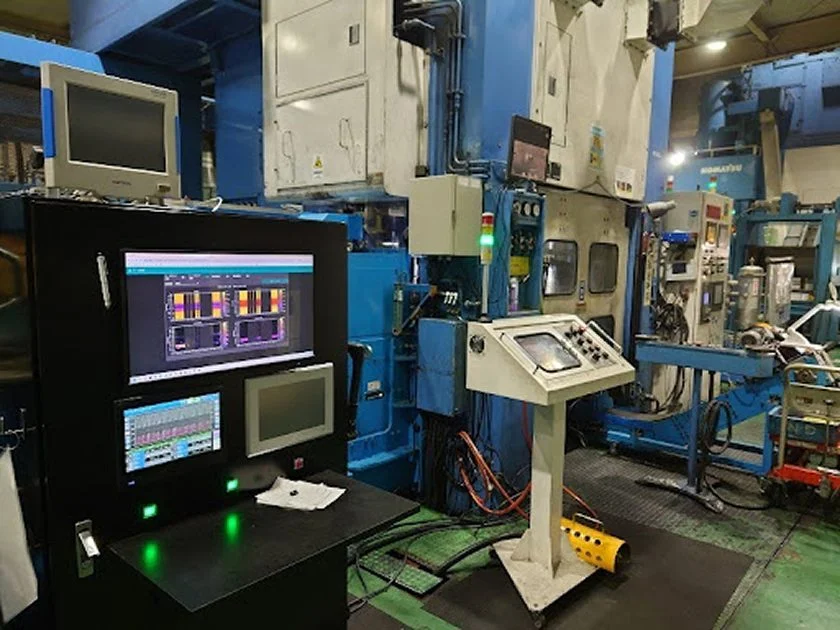
How It Works, Differences from Vibration Sensors, and Industrial Applications
An Acoustic Emission (AE) sensor is a monitoring technology that detects elastic waves generated inside materials, enabling early detection of abnormal conditions.
Unlike conventional vibration monitoring, AE sensors can capture early-stage damage that is otherwise difficult to detect, making them highly effective for equipment condition monitoring and material diagnostics.
This article explains:
- The basic principles of AE sensors
- Differences from vibration sensors
- Practical industrial applications
【What You’ll Learn】
- The working principle and types of AE sensors
- Key differences between AE sensors and vibration sensors
- Practical use cases in manufacturing environments
What Is an AE Sensor?
An AE sensor (Acoustic Emission sensor) detects elastic waves released when a material undergoes:
- Deformation
- Crack formation
- Fracture
Because these waves originate from internal changes within the material, AE sensors can detect abnormalities before they become visible on the surface.
How AE Sensors Detect Abnormalities
What Is Acoustic Emission?
When a material is subjected to stress:
- Stored internal energy is suddenly released
- This release propagates as elastic waves
This phenomenon is called acoustic emission (AE).
Detection Process
The AE monitoring process works as follows:
- Stress is applied to a material, causing internal changes
- Elastic waves are generated inside the material
- Waves propagate to the surface
- AE sensors capture the signal and convert it into electrical data
- Monitoring systems analyze the data to assess the material condition
Key Characteristics
- Frequency range: tens of kHz to several MHz
- Not detectable by human hearing
- Enables non-destructive testing (NDT)
his allows detection of microscopic internal damage without breaking the material
Types of AE Sensors
1.Resonant AE Sensors
- Designed to be sensitive to a specific frequency range
- High sensitivity for targeted signals
Best for:
- Detecting specific known failure modes
2.Broadband AE Sensors
- Capture a wide frequency range
- Provide more comprehensive waveform data
Best for:
- Complex failure analysis
- Root cause identification
AE Sensors vs Vibration Sensors
AE sensors and vibration sensors are fundamentally different technologies.
| Item | AE Sensor | Vibration Sensor |
| Detection Target | High-frequency elastic waves | Mechanical vibration |
| Detection Timing | Early-stage damage | After damage progresses |
| Frequency Range | High (kHz–MHz) | Lower (Hz–kHz) |
| Application | Crack detection, material monitoring | Equipment condition monitoring |
Key Difference
- AE sensors detect damage before it becomes visible
- Vibration sensors detect issues after physical movement or looseness occurs
Advantage in Low-Speed Equipment
- Vibration signals are often too weak to detect
AE sensors:
- Detect microscopic internal changes
- Are effective regardless of rotational speed
Ideal for slow-moving or high-precision machinery
Practical Applications of AE Sensors in Precision Forging
AE sensors are widely used in precision forging environments to improve quality and reliability.
1.Detection of Internal Cracks
Internal cracks are difficult to detect visually but can cause:
- Product failure after shipment
- Significant quality issues
AE sensors:
- Detect microcracks during processing
- Enable real-time inspection
Benefits
- Reduced material waste
- Improved yield
- Prevention of downstream defects
2.Die Condition Monitoring
AE sensors monitor:
- Die wear
- Galling (surface damage)
Benefits
- Early detection of tool damage
- Prevention of catastrophic failure
- Optimized maintenance schedules
Leads to:
- Reduced downtime
- Extended die life
- Lower production costs
3.Automated Inspection in Noisy Environments
Forging and press processes generate:
- High noise levels
- Intense impact sounds
AE sensors provide:
- Objective detection using waveform data
- Monitoring beyond human perception
Enables:
- Automated inspection systems
- Standardized quality control
AE Sensors for Condition Monitoring and Quality Control
AE sensors enable:
- Early abnormality detection
- Preventive maintenance
- Data-driven quality management
In precision forging applications, they are used for:
- Crack detection
- Die condition monitoring
- Real-time process control
Digital Transformation in Forging (Forging DX)
Nichidai integrates AE sensors into advanced systems such as:
Intelligent Die Set
- Combines AE sensors with load and displacement sensors
- Monitors forming conditions in real time
Manufacturing Management System
- Processes multi-sensor data
- Visualizes die conditions during operation
Benefits
- Early detection of abnormalities
- Improved product quality
- Data-driven process control
FAQ
Can AE sensors be retrofitted to existing equipment?
Yes. AE sensors can be installed on existing die sets:
- Compatible with various press machines
- No major modifications required
How should AE sensors be used with load sensors?
- Load sensors measure applied force
- AE sensors detect micro-events (cracks, deformation)
Combining both enables:
- More accurate condition monitoring
- Higher diagnostic reliability
Is specialized knowledge required for data analysis?
Yes, advanced analysis requires expertise.
However:
- Integrated systems (e.g., IoT platforms)
- Multi-sensor data fusion
can simplify interpretation and improve usability in practice.
Conclusion
- Early fault detection
- Non-destructive inspection
- Advanced quality control
Compared to traditional vibration monitoring, AE sensors enable:
- Faster detection
- Higher sensitivity
- Better process understanding


